
Tags
Abdel Fattah al-Sisi, Andres Manuel Lopez Obrador, Daenerys Targaryen, Emilia Clarke, Hubert Blaine Wolfeschlegelsteinhausenbergerdorff, Luiz Inacio Lula da Silva, Mohammed bin Abdulrahman Al Thani, Pablo Picasso, Recep Tayyip Erdogan, St. Edward's Crown icon, Tudor Crown icon, Vague Statement: Kier Starmer, Vague Statement: Marcus Welby, Vague Statement: Rishi Sunak, Vague Statements: Joe Biden
Now and again, when I read online news, something triggers a reaction ranging from, ‘Finally, someone sees sense.’ or ‘Well done that man.’ to ‘That’s droll.’ or ‘Unbelievable!’ or ‘Stupid, stupid, stupid.’ and further reactions containing adjectives not suitable for a family-friendly blog. Here are three examples taken from today’s news offerings.
Vague Statements
Ever since the 7 October 2023 start of the Gaza war, I have been struck by the vagueness of many of the statements made by leading politicians and organisations. Today, the BBC and Al Jazeera are reporting about the wording of an upcoming UN resolution about the war. The resolution is a reaction to Israel’s Minister without portfolio, Benny Gantz’s, intention to launch a ground assault on the southern Gazan town of Rafah on March 10th if the remaining hostages are not returned to Israel. According to the Al Jazeera article:
‘The [UN] draft, seen by Al Jazeera on Monday, said the Security Council should underscore “its support for a temporary ceasefire in Gaza as soon as practical [my italics], based on the formula of all hostages being released” while also “lifting all barriers to the provision of humanitarian assistance at scale” in Gaza.’
What is meant by as soon as practical? You can’t assign a timescale, or other objectives, to the meaning of these words. There are too many participants involved in a temporary ceasefire agreement. The words constitute a vague statement of intent but have no substance to define achievement.
Other vague statements, highlighted in italics, about this war have come from:
US President, Joe Biden, 12 February 2024
‘On Sunday, Biden told Netanyahu in a phone call that he believes “a military operation in Rafah should not proceed without a credible and executable plan” for protecting and supporting the Palestinians sheltering there, the White House said in a statement.’
UK Prime Minister, Rishi Sunak, 31 October 2023
‘Prime Minister Rishi Sunak stressed the importance of taking all possible measures to minimise casualties and protect civilians in a call with Israeli Prime Minister Benjamin Netanyahu on Tuesday.’
Leader of the UK Labour Party, Kier Starmer, 18 December 2023
‘The Labour leader said there was a need “to get to a sustainable ceasefire as quickly as possible”, beginning with a pause in the fighting during which the remaining hostages seized by Hamas on 7 October can be freed and aid can enter Gaza.’
Archbishop of Canterbury, Marcus Welby, 13 October 2023
‘Amidst the chaos and confusion of war, and as much as is possible, I join the calls for Israel’s military response to be proportional and to discriminate between civilians and Hamas.’
Heir apparent to the British throne, Prince William, 21 February 2024
‘Prince William has called for an “end to the fighting as soon as possible“, in a strongly worded intervention on the Israel-Gaza conflict.’
All laudable sentiments but with no measurable means of assessing success or failure.
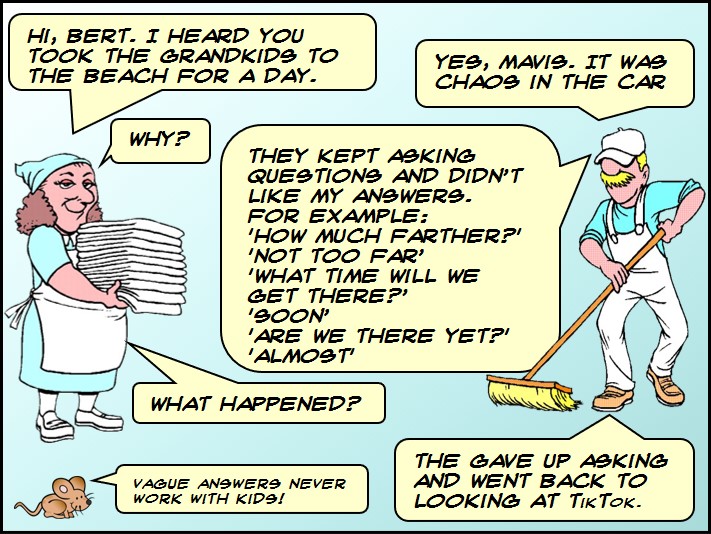
A Bert and Mavis cartoon.
For more Bert and Mavis cartoons, see Bert and Mavis: The First Fifty Cartoons
Vague answers don’t work, either!
Long names
This morning, a BBC website article mentioned Qatar’s Prime Minister, Mohammed bin Abdulrahman Al Thani, in his role as mediator in the conflict between Israel and Gaza. Mohammed bin Abdulrahman Al Thani. The length of his name made me think. Using the full name when writing about important people is politically correct and good manners. After all, we read about Rishi Sunak, not just Sunak; Joe Biden, not just Biden; Donald Trump, not just Trump, right? Referring to Qatar’s Prime Minister as Mohammed bin Abdulrahman Al Thani, not just Thani or al-Thani, is following protocol, but I need help when I hear these long names spoken on the radio.
I often listen to the BBC World Service at night when I can’t sleep and I am impressed with how the news presenters rattle off long names of prominent world leaders. The presenters have practised how to say these names quickly and correctly, but my hard-of-hearing impairment means that I can only work out the name if I take the trouble to see it written out. Here are four that, in the past, I have had to look up:
Brazil’s President: Luiz Inácio Lula da Silva. (Trips lyrically off the tongue.)
Turkey’s President: Recep Tayyip Erdoğan. (Beware the ğ. It’s pronounced like a w.)
Mexico’s President: Andrés Manuel López Obrador. (Another lyrical feast.)
Egypt’s President: Abdel Fattah al-Sisi. (Seesee or Sissy?)
While on the subject of long names, here are a few trivial facts.
The Guinness World Records lists the longest personal name as belonging to Hubert Blaine Wolfeschlegelsteinhausenbergerdorff, a recently-deceased German-born American typesetter. His complete 26 first A-to-Z names were Adolph Blaine Charles David Earl Frederick Gerald Hubert Irvin John Kenneth Lloyd Martin Nero Oliver Paul Quincy Randolph Sherman Thomas Uncas Victor William Xerxes Yancy Zeus. His unpronounceable surname contained 666 letters and tells a story about a village wolf killer whose ancestors came to Earth in a spaceship ‘powered by seven stone and iridium electric motors’.
For those of you who were enthralled by the antics of Daenerys Targaryen in HBO’s Game of Thrones drama series, you may want to know her full royal title. It is:
Daenerys Stormborn of House Targaryen
Princess of Dragonstone
The Unburnt
Queen of Meereen
Queen of the Andals, the Rhoynar and the First Men (claimant)
Lady of the Seven Kingdoms (claimant)
Protector of the realm (claimant)
Khaleesi of the Great Grass Sea
Breaker of Shackles
Mother of Dragons
That’s very impressive!
The actress who played Daenerys Targaryen was Emilia Clarke. Her full name is Emilia Isobel Euphemia Rose Clarke. Euphemia? That’s worth further research. (Greek in origin, it means well-spoken and may be reduced to Effie as a nickname. I suspect the Mother of Dragons would not have responded well to being called Effie. Enter any one of Drogon, Rhaegal, or Viserion?)
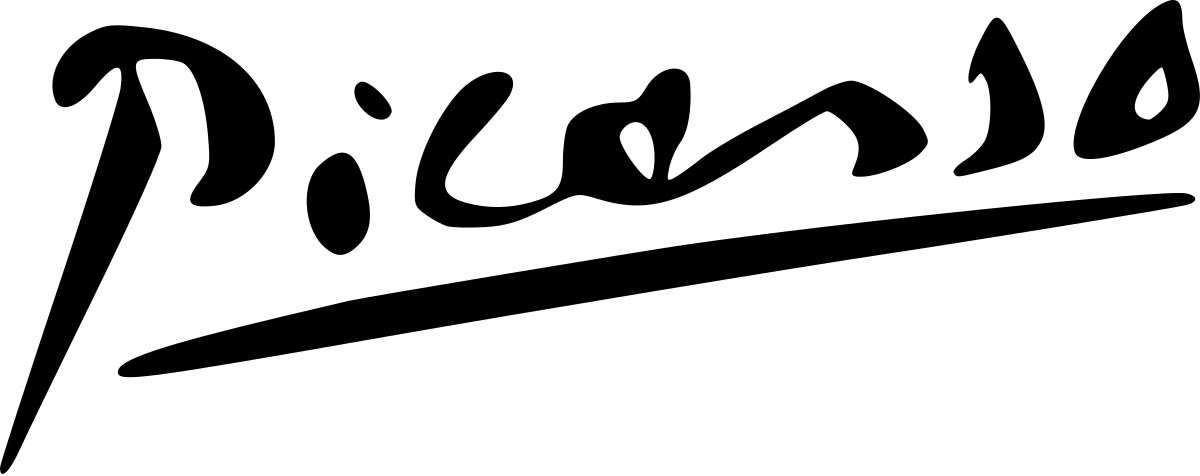
One more: Pablo Picasso. Wikipedia reports his full name was Pablo Diego José Francisco de Paula Juan Nepomuceno María de los Remedios Cipriano de la Santísima Trinidad Ruiz y Picasso. Picasso did sign his paintings, usually with just his surname, in a very recognisable style. Had he signed with his full name, there would have been very little room left for the painting!
If famous people with long surnames interest you, follow this link:
https://www.ranker.com/list/famous-people-with-long-names/celebrity-lists
Regal Crowns
This last example of ‘spotted in the news today’ comes under the category of droll.
Those of us who are UK citizens may have visited the official website of the UK government, www.gov.uk, touted as, ‘The best place to find government services and information’. Here’s what you get access to:
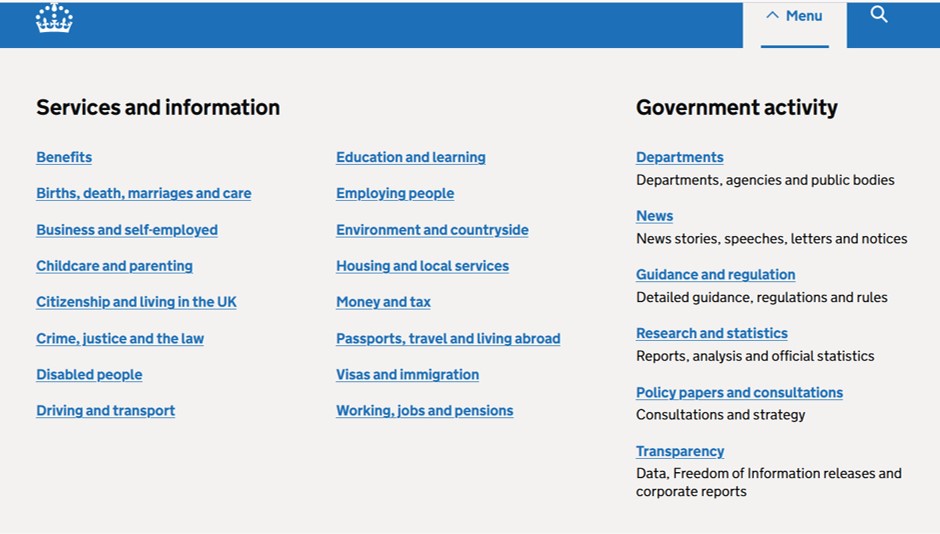
Do you see the small crown icon in the top-left-hand corner? Do you recognise it? It’s modelled on the Tudor Crown, also known as Henry VIII’s crown and worn by English monarchs from Henry VIII’s time as king, 1509 – 1547, until it was destroyed in 1649 during the English Civil War. A replica of the crown can be seen in Hampton Court Palace.
Why am I telling you about this crown and its iconic use on the gov.uk website? Because it’s a replacement for the St Edward’s Crown icon that used to be there during Queen Elizabeth’s reign over the citizens of the UK and other places. Queen Elizabeth 2 favoured the crown of Saint Edward, but her successor, King Charles 3, is more inclined to the Tudor crown. Here are the two icons:
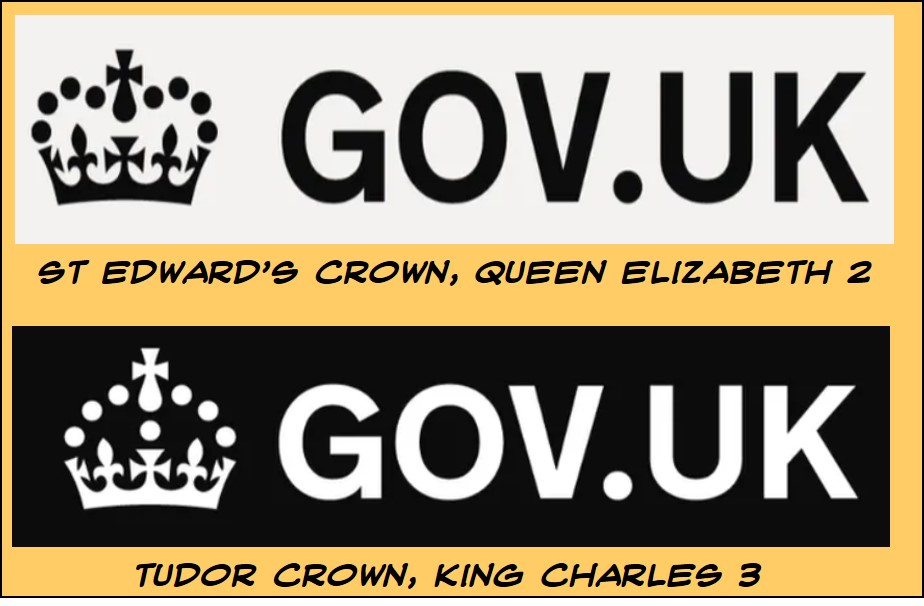
The difference between the two icons is minimal. Starting with the St Edward’s crown, the two large dots adjacent to the central cross pattée have moved vertically upwards, and one new large dot has been inserted below the central cross pattée to form the Tudor crown. The headband and alternating fleurs-de-lis and crosses pattée remain unaltered. In the BBC article, ‘Deputy Prime Minister Oliver Dowden says the government “takes pride” in the change, and it [moving three large dots?] was funded from the website’s usual operating costs.’ That’s all well and good. Replacing one image with another one a website or headed notepaper is a trivial task but the repercussions of these changes are enormous. Everywhere the St. Edward’s crown was used as an icon or as part of a royal cypher in Queen Elizabeth’s reign must now be updated to the Tudor crown. Everywhere! This includes post boxes, police uniforms, official buildings, official documents, official portraits, Beefeaters’ uniforms, coins, banknotes, stamps, passports, and even the badge on the jacket of the King’s Swan Master who is the member of the Royal Household responsible for monitoring the health of the swans. I kid you not!
Sometimes, I wonder why we do things like this. It’s part of our tradition, you say. Or it keeps people employed or specific wheels of industry turning. Or it’s whimsical, but we are a nation that enjoys whimsicality. I find it amusing but wonder what else the government could have done with the money it will cost.
(^_^)
 Ben's Blogs, Books & Pix