
Tags
Ambiguous It Hunter, English grammar, Indefinite Pronouns, Lipika Pelham, Ralph Evans (Editor), Rubymar
‘Beware the indefinite pronoun with an undefined antecedent!’
Ralph Evans, Editor, IEEE Transaction on Reliability, 1973, private correspondence
In July 1973, I attended a conference at Liverpool University. Following a presentation by a speaker in the nuclear power industry on a topic close to my university research, I offered some further insights during the post-presentation question time. Ralph Evans, the editor of a respected American professional journal, was in the audience and spoke to me afterwards about what I had said. At the end of our conversation, he invited me to submit a paper to his journal, elaborating on my comments. I did this, and after further research, I sent him my paper. You can read the full story of what happened next in my 2013 book, “On one occasion…” Ivory Tower and Road Warrior Stories, but here is the relevant extract:
When I sent my contribution to Ralph Evans, he replied along the following lines.
‘Thank you for your contribution. Technically, it’s fine, but grammatically, you do have a tendency to use the indefinite pronoun with an unclear antecedent.’
What! What the hell was the indefinite pronoun? What was meant by its antecedent? And how dare an American tell me, an Englishman, that I could not write my native language correctly?
He did, and I couldn’t!
Ralph’s words challenged me first to find out what he meant and second to make sure I would never again be accused of writing sloppy English. The indefinite pronoun, in this case, is ‘it’. If you start a sentence using ‘It’, the noun it refers to lies somewhere in a previous sentence and, in some cases, may not be easy to identify. For example, ‘The cat sat on the mat. It was tabby.’ What was tabby? The cat or the mat? The rules of English grammar will tell you that in a case such as this, the indefinite pronoun refers to the last proper noun mentioned – the mat, but I suspect that the author of these two sentences probably meant that the cat was tabby.
Extract: “On one occasion…” Ivory Tower and Road Warrior Stories, 2020 (Paperback Edition), page 39.
With this story as background, let me tell you what has prompted me to write today’s blog.
On today’s BBC website is a report about the sinking of the Rubymar. You may recall that two weeks ago, the Iran-aligned Houthi group fired missiles at the cargo ship Rubymar while it was working its way through the Bab el-Mandep Strait between the Gulf of Aden and the Red Sea. Two missiles struck the vessel, causing it to start taking in water. Yesterday, the Rubymar sank. You can read about it here:
https://www.bbc.com/news/world-middle-east-68457445
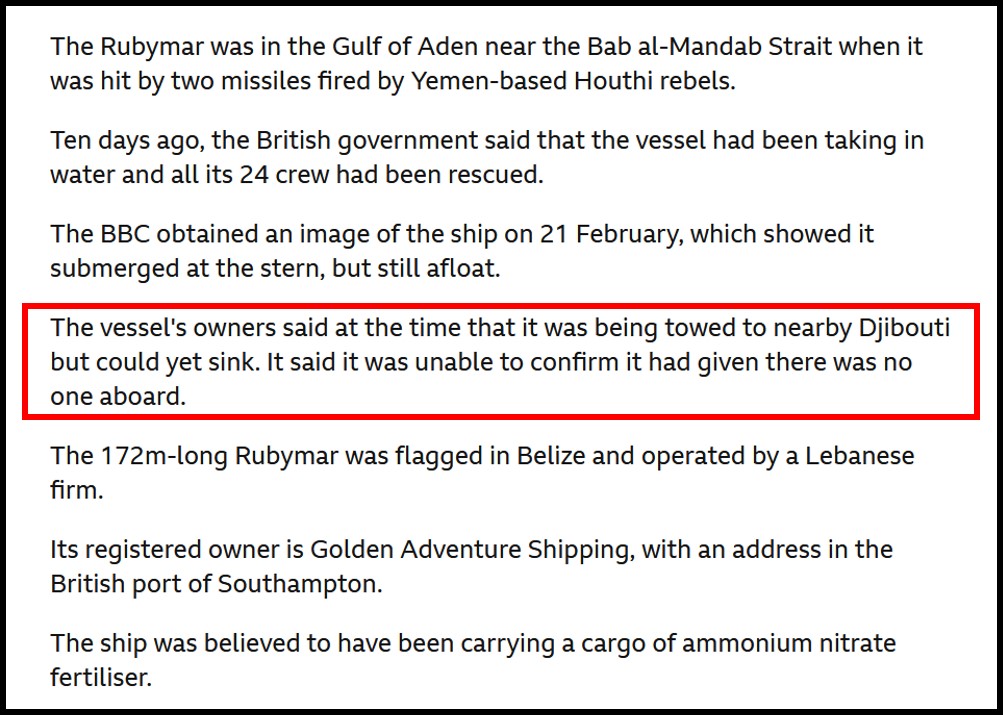
Extract: BBC article on the sinking of the Rubymar, 3rd March 2024
If you do read the article, you will come across this mini-paragraph:
The vessel’s owners said at the time that it was being towed to nearby Djibouti but could yet sink. It said it was unable to confirm it had given there was no one aboard.
The second sentence caused me distress. There are three instances of the indefinite pronoun, it, in this sentence. To what noun or nouns in the previous sentence, or even earlier, do they each refer? The ship or the vessel’s owners? Maybe the intention was to write, ‘They [the vessel’s owners] said they were unable to confirm that the ship had sunk [or arrived?] given [that] there was no one aboard’. Alternatively, maybe the intention was to write, ‘They [the vessel’s owners] said they were unable to confirm they had given an assurance there was no one aboard [in case the ship sunk before arriving in Djibouti]’. I suspect the first version is what was intended but there is still confusion about sinking versus arriving.
Following Ralph’s 1973 gentle disapproval of my casual use of it, I have become an Ambiguous It Hunter, seeking out possible it ambiguities and clarifying meaning. As no official organisation is looking after the rules of English Grammar, I look to the BBC as one of the unofficial keepers of the language. The article’s author, Lipika Pelham, is an acclaimed author, historian, journalist and documentary filmmaker. As such, I suspect the errors in her article are not of her making; probably more so the BBC copy editor who checked her article or a grammar-checking program? I hope there is a simple explanation.
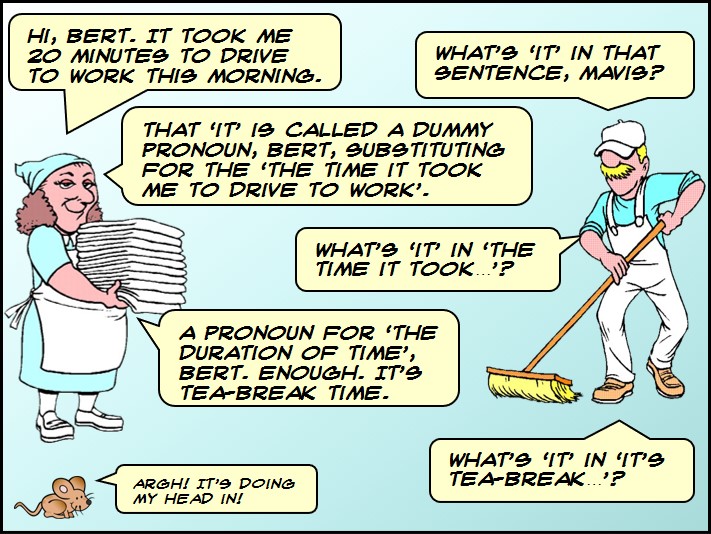
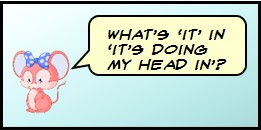
Bert and Mavis cartoon.
For more Bert and Mavis cartoons, see Bert and Mavis: The First Fifty Cartoons
(^_^)

