
Tags
20000 Elephants, 20000 Elephants from Botswana to Germany, April Fool's Day!, Arthur Higgins, Botswana, Botswana Cabinet Meeting, Mokgweetsi Masisi, President Mokgweetsi Masisi
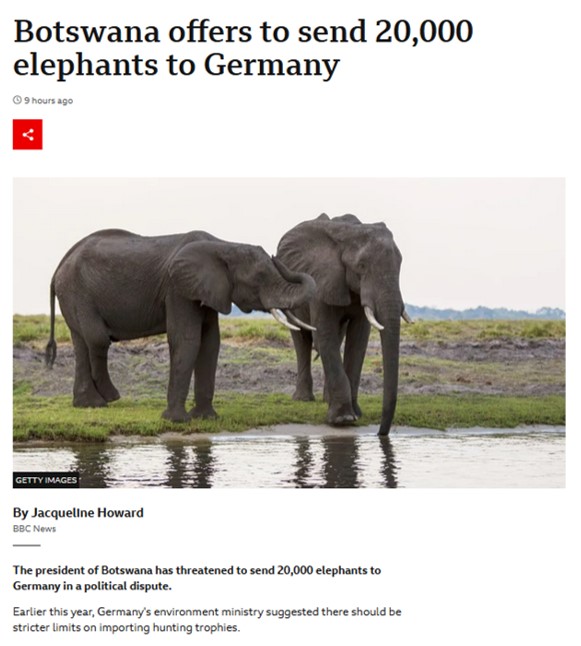
BBC Website, 3 April 2024
https://www.bbc.co.uk/news/world-68715164
How do you do it? How do you transport 20,000 elephants from Botswana to Germany? That’s what Botswana’s President, Mokgweetsi Masisi, has threatened to do if Germany imposes stricter limits on importing hunting trophies. Importation of ivory is now banned throughout all EU countries but, presumably, other hunting trophies, such as skulls, feet, hide, hair or teeth, are still allowed? The problem for Botswana is they have too many elephants. One-third of the world’s population of elephants live and breed in Botswana. 130,000 elephants roam Botswana’s national parks, deltas, and game reserves, causing damage to crops, occasionally trampling people to death, and encouraging poachers to harvest their tusks. President Masisi has recently re-introduced controlled elephant trophy hunting to cull the animals and generate income from hunting tourists. Germany’s threat to impose stricter limits on imported hunting trophies may impact Botswana’s economy. In an article published in Bild, President Masisi wrote:
“It is very easy to sit in Berlin and have an opinion about our affairs in Botswana. We are paying the price for preserving these animals for the world,” he said. Germans should “live together with the animals, in the way you are trying to tell us to”. “This is not a joke,” said Masisi.
And, sure enough, President Masisi was not joking. Two days ago, he called a meeting of select cabinet members. The meeting’s objective was to come up with a cost-effective way to transport 20,000 elephants from Botswana to Germany if Germany’s President Frank-Walter Steinmeier decided to call his bluff. The Botswanan President, impressed with our intrepid journalist Arthur Higgins’ illuminating interview with Benjamin Netanyahu, invited Arthur to attend the meeting as an observer (no speaking or voting rights). Arthur duly travelled to Gaborone and witnessed the event.
Here is the transcript from the meeting.
Emergency meeting of Botswana’s Cabinet
Gaborone, 1 April 2024
Present at the meeting
Mokgweetsi Masisi, President of Botswana
Slumber Tsogwane, Vice-President of Botswana
Emma Peloetletse, Permanent Secretary
Lemogang Kwape, Minister of Foreign Affairs
Peggy Onkutlwile Serame, Minister of Finance
Eric Mothibi Molale, Minister of Transport and Communications
Philda Kerang, Deputy Minister of Environment and Tourism
Arthur Higgins, Journalist (observer status only)
Masisi: Welcome to this emergency meeting. The problem under discussion is how to transport 20,000 elephants to Berlin if Frank calls my bluff. I’m open to all ideas, no matter how ridiculous they may sound. Eric, as T&C minister, what are your thoughts?
Molale: Sisiboy [Ed’s note: Masisi’s nickname, used only by family and close friends], I’ve given it some thought. As the crow flies, there are 8,667km between Gaborone and Berlin, but a direct route would require passage across the Mediterranean Sea.

Kwape: I went onto the Rome2Rio website. They had various flight options, the best of which was to fly the elephants directly from Gaborone to Berlin, a flying time of just over 16 hours. A wide-body air freighter, such as a Boeing 747-400F, can carry as many as 26 elephants per flight. 20,000 elephants would require 770 flights. I reckon the cost would be enormous, bigger than Botswana’s GDP, and animal welfare requirements would be very demanding. How about a land route?
Molale: I looked into this option. Maximising travel by land would take the elephants up through Africa to Egypt and then through the Rafah Crossing into Gaza continuing upwards through Lebanon into Turkey and across the Bosphorus into Bulgaria on a night train from Halkali (Istanbul) to Svilengrad (Bulgaria), and, finally, to Berlin in Germany – a distance of 12,724km.

Tsogwane: Whoa, wait up Eric. Get real. First, Gaza is not a happy place right now. I doubt the Israel Defense Force would allow the unhindered passage of 20,000 elephants through to Lebanon. Second, an elephant walks at an average pace of 7km/hr for up to 22 hr/day. Thus, the maximum distance an elephant can travel in one day is 154km. But, as we long-distance savannah walkers well know, when walking in a group, you can only walk at the pace of the slowest walker. The same applies to elephants. Let’s assume that the average pace of an elephant is more like 5km/hr and that frequent stoppages reduce the walking time to, say, 20hr/day; this means the herd will cover, at most, 100km/day, not 154km/day. The best case, then, is the journey will take 127 days – just over four months. Then there are questions of feeding and watering the herd and clearing up their dung. Did you know an adult elephant can produce up to 100kg of dung/day? 20,000 elephants, dung-dumping along the way, will leave two million kilograms of dung per day as they move serenely up through Africa and into Europe. I suspect the residents along the way will…
Molale, interrupting: Okay, okay. We get it, Slumber. Overland travel is out of the question…
Kerang, muttering under her breath: Hannibal had problems with just 37 elephants. Nearly all of them died crossing the Alps. What chance have we got?
Molale: Yes, Philda. Thanks for that enlightenment. Any other ideas?
Serame: Let’s forget transport by air or land. How about travel by sea? We could transfer the animals up the west coast of Africa and Europe and unload them in Warnemünde on the Baltic Sea coast.
Molale: I looked into this possibility. If we can get all the elephants into Gaborone’s dry port container terminal, GABCON, we can move them by train to any one of South Africa’s sea ports at Cape Town, Port Elizabeth, East London, or Durban and then on by ship to Warnemünde or Hamburg. I looked into the cost – how many elephants per ship, total distance, time at sea, logistics, …
Masisi, interrupting: Wait a minute! These solutions are becoming way too complicated and costly. Let’s try some out-of-the-box ideas. Anyone?
Peloetletse, hesitantly: I have an idea. We will halve some of the costs if we ship 10,000 pregnant elephants. Germany will eventually get its 20,000 elephants. A sort of buy-one-get-one-free strategy.
Serame: I like the cost reduction factor, but where will we find 10,000 pregnant elephants in roughly the same state of gestation? An elephant’s gestation period is 22 months. We will need 10,000 pregnant elephants at the start of this period, not the end. I wouldn’t want an elephant to give birth on an aircraft, train, or ship.
Peloetletse: Okay, scrap that idea. Here’s another: Why don’t we ship 20,000 dead elephants? After all, Mr. President, you didn’t specify live elephants!
Masisi: That’s true, but shipping 20,000 carcasses is almost as tricky as 20,000 live animals.
Peloetletse: I didn’t say carcasses. We could slaughter 20,000 elephants, cremate them on a huge bonfire, place the ashes in traditional Botswanan earthenware pottery made by the women potters of the Bakgatla ba Kgafela community in south-eastern Botswana, and ship them to Berlin.
Masisi: Hmm, that’s a more interesting thought. But it will take time to gather enough pots to hold all the ashes, and we would have to pack them very carefully to reduce the possibility of breakages during transport. But I think we are closing in on a solution, Botswana. [Ed’s note: Botswana is the colloquial Botswanan equivalent of folks.] Do you have any other suggestions?
Higgins, raising his hand: Permission to speak, Mr President?
Masisi: Arthur, yes, but keep it short.
Higgins: Why not ship 20,000 small plastic elephants with ‘With Love from Botswana’ written on one side to your political colleagues in Germany?
Masisi: Yes! Brilliant, Arthur, absolutely brilliant. But where can we obtain 20,000 small plastic elephants quickly and cheaply?
Higgins: China! I know a man with a factory who can make them quickly and cheaply. He will even ship them directly to Berlin for you. Problem solved!
Masisi: Slumber, give that man a POB medal. Peggy, work with Arthur and place the order. Lemogang, call Frank and tell him the elephants will be arriving shortly. Philda, prepare a press release. The rest of you, go home, hug your children, and take the rest of the day off. We’re done with today’s meeting. Ke e leboga, my friends, and thank you, Arthur.
And so, once again, Arthur Higgins saved the day by removing a potentially embarrassing situation for a prominent politician. He returned home to be welcomed by his beloved border collie, Snowflake, and basked in the glory of the Presidential Order of Botswana, the honour bestowed upon him by his new friend, Mokgweetsi ‘Sisiboy’ Masisi, President of Botswana.

Bert and Mavis cartoon.
For more Bert and Mavis cartoons, see Bert and Mavis: The First Fifty Cartoons
(^_^)
 Ben's Blogs, Books & Pix