
Tags
Compelling reason, Decision making, Making Decisions, Reciprocity, Remove ambiguity, Self-help techniques, Spider Diagrams, Stephen Covey, Symptom and Cause, The 6 Why Technique, The 7 Habits of Highly Effective People, The bounty of saying sorry, Use nouns not pronouns, Want versus need, What problem are you solving?, Will I ever regret...?
Many years ago, while travelling in a car through the streets of an Asian city, I passed a crowd outside the entrance of an upmarket hotel and with a limousine disgorging a tall, well-dressed, bald gentleman about to walk into the hotel on what appeared to be a red carpet. ‘Who’s that?’ I enquired of my host driving the car. ‘That’s Stephen Covey,’ came the reply. ‘He making a presentation in that hotel tonight.’ ‘Who’s Stephen Covey?’ I asked. ‘Probably the biggest name among current self-help gurus,’ my companion said in a tone that expressed incredulity that I didn’t know who Stephen Covey was. ‘He’s written a famous book called The 7 Habits of Highly Effective People. He’s on a tour around the major Asian-Pacific cities.’ ‘Oh,’ I said, thinking I ought to check him out.

The 7 Habits of Highly Effective People, Stephen Covey
Free Press, 1989/Simon & Schuster, 2020.
On my return from the Asian trip I bought a copy of his book, a weighty tome considerably thicker than most of the technical books on my bookshelf, and settled down to read the great man’s words of wisdom and see if they would make a better man of me. They didn’t. I got as far as halfway through Part 2 and gave up. Part 1, Paradigms and Principles, said it all. From then on, he seemed to be repeatedly telling me the same thing, using different words. I became bored and settled back into working out my own ‘rules’ on how to develop habits that made me effective, but for those of you who are interested, here’s a summary of Covey’s 7 Habits:

Be Proactive
Take responsibility for your life and actions, and focus on what you can control rather than what you can’t.
Begin with the End in Mind
Define your goals and purpose in life, and use them as a guide to make decisions and prioritize your actions.
Put First Things First
Prioritize your time and energy on the essential things in your life, and learn to say “no” to less important things.
Think Win-Win
Seek mutual benefit in all interactions and relationships, and look for solutions that benefit all parties involved.
Seek First to Understand, Then to Be Understood
Listen empathetically and seek to understand others’ perspectives before expressing your own.
Synergize
Work collaboratively with others to achieve goals and create outcomes more significant than any individual could achieve alone.
Sharpen the Saw
Take time to renew and improve yourself physically, mentally, emotionally, and spiritually for continued success.
Back to my habits. I don’t think of them as habits. They are more ways of behaving and methods for making decisions. I didn’t get them from books or other sources, not that I’m aware of, although I am sure others have presented and expounded them. In simple terms, here they are.
Ways to Behave
There is an assortment of behavioural guidelines such as being fair, being non-judgemental, being non-discriminatory, respecting the beliefs and opinions of others, being empathetic, being non-violent, being kind, not cruel, and so on. These well-known and general behavioural guidelines occurred naturally to me and required no further exposition. However, the five behavioural guidelines below were formulated through personal events and, as a result, are somewhat unique.
1. Define ambiguous words and beware of pronouns replacing nouns.
Both during my professional life as a teacher/lecturer and, more recently, as deafness has taken hold, I have found it necessary to define certain words I use before using them and to request the identities of those hiding behind pronouns. As a teacher of complex principles of design-for-test as it related to electronic systems, I quickly discovered that what a word meant to one electronic engineer was not what another electronic engineer understood. Take the word system just used. An engineer in the microelectronics industry would consider this meant a microprocessor or something more complex but still within the realm of microelectronic devices, whereas an engineer in the communications industry would perceive it to be an array of computers, or a radar system, or a 4G/5G network system, or similar.
Deafness raised the issue of pronouns. If I’m in a group discussion about people we know and I miss the opening sentence in which someone is named, all subsequent sentences that now use a pronoun when referring to the named person become meaningless to me. I have two options: interrupting and asking who ‘he’ or ‘she’ is or fading out of the discussion. The recent tendency to introduce ‘they’ to represent someone who identifies as transgender has made my comprehension of the conversation more difficult.
In general, ambiguity of meaning always causes me difficulty. My specialised branch of digital electronic engineering was based on Boolean logic – true or false, nothing in between – and this has influenced the way I write and formulate the spoken word. My quest is to search for and remove ambiguity. Many English words have multiple meanings, a property known as polysemy. Here’s an example from one of my books, The Wondrous Wacky World of Words:
Barry Barnes, an ex-member of the Bar, is now barred from entering the bar because he brandished a metal bar to punish all within the bar, bar the barman.
Even a simple statement, such as I hit the man with a book, is ambiguous. Was the man I hit carrying a book, or did I use a book to hit him? Or how about this one:
Customer in a clothes shop: May I try on that dress in the window, please?
Shop assistant: No, ma’am. You’ll have to use the fitting room like everyone else.
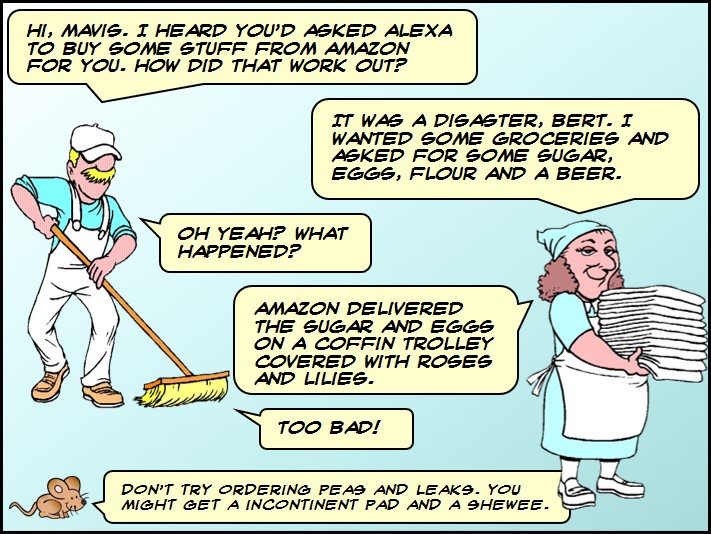
A Bert and Mavis cartoon.
For more Bert and Mavis cartoons, see Bert and Mavis: The First Fifty Cartoons
Searching for and removing ambiguity has, in the past, caused me to be labelled a pedant! I never did work out if that was a compliment or a derogation.
2. Ask why at least six times
When I branched out as a consultant in my chosen field of digital electronic engineering, I quickly learnt the first rule of consultancy: to find the root cause of a problem, keep asking why. After six whys, you will have reached, or be very close to the root cause and can then think about how to fix it. Here’s an example:
– My car won’t start this morning.
– Why?
– There’s no fuel in the tank.
– Why?
– Because I forgot to fill up yesterday.
– Why?
– Because I didn’t look at my to-do list before leaving home.
– Why?
– Because I overslept and was in a rush.
– Why?
– Because my alarm clock didn’t wake me up at the usual time.
– Why?
– Because the batteries need replacing.
– Buy and fit new batteries in your alarm clock. That’ll be £1,000 consulting fee plus expenses!
3. Identify the cause of a problem rather than treat the symptoms.
This guideline relates to the previous guideline. In my professional career, I was involved with techniques to determine if a newly-minted electronic product contained a manufacturing defect that would cause a malfunction. This process is known as manufacturing defect detection, but there was a vital follow-on requirement called manufacturing defect location or diagnosis: if you detect the presence of a manufacturing defect, find its location, determine what caused it, and remove the cause from future manufactured products.
These days, I apply this principle to health issues. If, for example, my blood pressure starts to rise alarmingly, should I take blood-pressure reduction pills, or should I identify the cause, overweight maybe, and change my diet to lose weight? Do I treat the symptom or identify and remove the cause? My preferred behaviour is to identify and remove the cause.
4. Learn to say sorry
Sometimes, the hardest word to say is sorry: after an argument during which harsh words are spoken; when you’ve done something stupid but don’t like to admit it; or when you have been unduly critical of another person’s behaviour and caused a tearful or angry reaction. In any relationship – marriage, civil partnership, family, business – these things happen and that one little 5-letter 2-syllable word is a great healer. Learn to say it. Swallow your pride, your conviction that you are right, your desire not to give way, or whatever stops you from saying it. In the end, what matters is a continuation of your relationship. Once one of you has said the word, the other usually reciprocates and you are back on the sweet path of ‘kiss and makeup’ either for real or metaphorically. Sorry is a small word to say but capable of eliciting a powerful response.
5. Apply reciprocity
Reciprocity is one of life’s great guiding principles and needs no elaboration. Many people are credited with stating the principle. One that I like is that of the Chinese philosopher Confucius. In the book The Analects of Confucius, he writes:
Zi Gong asked: ‘Is there any one word that can serve as a principle for the conduct of life?’ Confucius said: ‘Perhaps the word ‘reciprocity’: Do not do to others what you would not want others to do to you.’
I prefer the more positive way of stating it – do unto others as you would others do unto you – but the concept is clear however you express it.
Ways for Making a Decision

Example of a spider diagram used to assess a job offer
6. Will I ever regret it if I do not…
Throughout our lifetime we often have to make decisions: personal, financial, situational, emotional, strategic, tactical, policy,… We have our own ways to make decisions and act on the result accordingly. In my case, my engineering background led me to develop an analytical technique. In the early days of my post-graduate professional career, I drew stick diagrams (more commonly called spider diagrams, I found out), where each branch represented one of the influencing factors. I would look at the final diagram and reach a conclusion. But in 1979, the technique failed me.
In 1979, after seven years of lecturing and researching in Southampton University’s Department of Electronics, I received a phone call from Clive Crossley. In 1978, Clive and a colleague, Robert, started a company, Cirrus Computers, in Fareham, a town close to Southampton. I had research knowledge and presentation skills that Clive needed to grow Cirrus Computers, and he offered me a position in the company.
Here’s what happened as described in my book, On One Occasion…’ Ivory Tower and Road Warrior Stories.
The decision to join Cirrus Computers was an agonizing one. I was doing well at Southampton University. My salary was reasonable. I had successfully supervised others to PhD level. My publication count was steady, averaging three to four technical papers per year (a good average). I was in line for promotion from Lecturer to Senior Lecturer and, eventually, a full Professorship. Should I risk all this to join a flaky startup down the road with two directors, Clive and Robert, and two employees?
I recall drawing what I called a stick diagram, similar to a decision tree, with a matchstick man representing me in the middle of the page and multiple branches labelled Financial, Domestic, Risk, Career Opportunities and so on, emanating from my Lowryesque image. I must have stared at this piece of paper for many hours before it hit me – the big question: “If I do not accept this offer, will I ever regret it?” Once this question had bubbled to the surface, the answer was immediate – “Yes. Accept the offer”.
Thus, in mid-1979, I resigned from my safe academic position at Southampton University and joined Cirrus Computers, where I eventually became a director of the company.
–oOo–
This particular question subsequently became important again several times after it first surfaced in 1979. In particular, when I:
- started my one-man-band consultancy in 1986;
- joined an American company located in Silicon Valley, California in 1993 (and moved to the Valley, leaving my wife and three children in the UK);
- joined another Silicon Valley startup in 1995 and relocated back to England; and, finally,
- restarted my consultancy in 1997.
I believe this question towers over the analytical decision process I used because it introduces a subjective element into the process and helps me see through the maze of technical factors. Every time I’ve used this question to finalise a multi-faceted difficult decision, I have not regretted the end result. When you struggle with career-based decisions or important family decisions such as relationships or house movement, ask yourself, ‘Will I ever regret it if…?’
7. Everyday decision questions: What problem are you solving? Do I need this …, or want this…? Is there a compelling reason to…?
I call this group of three related questions my everyday working decision-making questions. They come to the fore when making a range of purchase decisions, from something as trivial as a replacement saucepan to the all-important decision of house moving. Last year was a case in point when my wife and I decided to put our house on the market and downsize to a smaller place. We liked where we were; we were not in financial difficulty; there were plenty of spare rooms for when our children or grandchildren visited; and the location was excellent, but the house was becoming too big for us. Old age was starting to make it difficult, and sometimes risky, to climb and descend the 32 steps between the top and bottom of the house. The garden stretched my wife’s ability to keep it neat. (I don’t do gardening!) Family stayover visits reduced as the granddaughters started their adult lives. Heating bills were rising faster than savings interest rates. Internal walls needed redecorating, and external woodwork required repainting. Some interior carpets needed replacing. A few slipped and broken roof tiles needed repairing. We were rattling around in a house that had become too big for us and needed some attention. So, the problem we were solving was that the house had become unsuitable for our ageing years, and the compelling reason was mainly financial: release equity and use it to buy and refurbish a smaller more comfortable place. And that’s what we did.
There you have it. These are my 7 Habits of Effective Life-Style Behaviour and Decision Making. They’ve worked for me. They may work for you.

(^_^)
 Ben's Blogs, Books & Pix